


Gut Health and Immunity: Why Your Gut Is Your Greatest Winter Defence

Last week, my four-year-old came home from preschool with a runny nose. Within three days, the whole house had it. That is winter with children.
I used to think winter health was about avoiding every bug. Take enough vitamin C, wash your hands obsessively, and maybe you can dodge the season entirely. But after years of studying nutrition and watching how my own family moves through winter, I realised that is not how resilience works.
The real question is not whether you get sick. The real question is how well your body recovers when it does.
And most of that answer lives in your gut.
70% OF YOUR IMMUNE SYSTEM LIVES IN YOUR GUT
This is not a metaphor. Approximately 70% of your immune cells are located in the gut-associated lymphoid tissue, with 80% of plasma cells residing there. Your gut is not just digesting food. It is running constant surveillance, training immune cells, and deciding what gets through and what gets fought off.
When gut health is strong, your immune system has the infrastructure it needs to respond quickly and recover efficiently. When gut health is compromised, everything downstream struggles.
I see this pattern constantly in clinical practice. Clients with strong gut health tend to recover faster from winter bugs, experience milder symptoms, and do not get stuck in the cycle of back-to-back illnesses. Clients with poorer gut health, higher stress levels, or low nutrient intake often get hit harder and take much longer to bounce back.
The difference is not luck. It is foundation.
HOW GUT HEALTH AND IMMUNITY SHAPE WINTER RESILIENCE
Most people think eating healthy means eating more vegetables. That is true, but incomplete. What actually drives gut health is variety.
Your gut microbiome thrives on diversity. Different plant foods feed different bacterial strains, and those bacteria produce short-chain fatty acids that reduce inflammation, strengthen your gut barrier, and support immune regulation.
Recent research shows that plant-based diets stimulate bacterial growth necessary for producing these short-chain fatty acids, which help reduce inflammation, enhance gut barrier integrity, and improve metabolic health. The transformation of 775 phytonutrients from edible plants is associated with enzymes encoded by diverse gut microbes.
Translation: the more variety you eat, the more tools your gut has to keep you resilient.
I used to eat the same breakfast every day, rotate through maybe five dinners, and think I was doing fine. But once I understood the gut-immune connection, I started tracking plant diversity. Within a few months, I noticed significant changes in my own energy levels and how my family moved through winter.
We still got sick. But we recovered faster, and the illnesses felt more manageable.

THE SOIL-PLANT-GUT AXIS YOU DID NOT KNOW EXISTED
Here is something most people miss: the microbes on your food matter.
Groundbreaking 2025 research revealed that microbes from fruits and vegetables can survive the journey through your digestive tract, at least temporarily, contributing to gut bacterial diversity. The microbiomes of fresh produce and the human gut share common members such as Enterobacterales, Burkholderiales, and Lactobacillales.
This creates a continuum from soil to plant to gut that directly influences immune resilience.
That means every time you eat a colourful vegetable, you are not just getting vitamins and fibre. You are introducing beneficial microbes that support the ecosystem in your gut.
Your gut is not isolated. It is connected to the soil, the plants, and the diversity of the food system around you.
BEANS, LENTILS, CHICKPEAS ARE IMMUNE POWERHOUSES
If I had to pick one food group that gets overlooked during winter, it would be legumes.
Beans, lentils, and chickpeas are exceptionally high in resistant starch, making them superior prebiotics. Without enough prebiotics in your diet, gut bacteria begin to consume the mucins that form the first line of immune defence on your intestinal lining.
Legumes literally protect your gut's immune barrier from being degraded.
Lentils also demonstrate strong inhibitory activity of both 15-LOX and COX enzymes, which are proteins that induce inflammation. They prevent deficiencies in critical minerals like iron, folate, zinc, and manganese that your body relies on to maintain a strong immune system.
When I make soup for my family during winter, legumes are non-negotiable. One cup of lentils in a pot of soup adds fibre, plant protein, minerals, and gut support without changing the flavour profile dramatically.
It is one of the easiest ways to increase nutrient density and plant diversity in a single meal.
COLOUR DIVERSITY IS NOT JUST AESTHETIC
Phytonutrients are often colour-specific. Foods of the same colour contain similar types of phytonutrients, which is why leading health organisations recommend eating a rainbow.
These compounds can regulate immune responses, increase the number of specific immune cells, and enhance immune activities. Certain phytonutrients modulate immune system function to maintain the delicate balance between overactive and under-active responses.
When I am building a soup or stew, I mentally check for colour. Red capsicum, orange carrot, green spinach, purple cabbage, white onion. If I can get five different colours into one pot, I know I am covering a wide range of phytonutrients.
It is not complicated. It just requires intention.
VARIETY OVER VOLUME: THE REAL METRIC
Most people focus on eating more vegetables. I focus on eating more types of vegetables.
A diverse gut microbiome is linked to better digestion, stronger immunity, and lower risk of many chronic diseases. Machine learning models based on 2,486 public case-control microbiomes show that the abundances of enzymes associated with modification of phytonutrients in health-associated foods can discriminate health status in multiple disease contexts.
This suggests altered biotransformation potential in disease states.
Translation: when your gut lacks diversity, it cannot process nutrients as effectively, and your immune system suffers.
I encourage clients to aim for 20 to 30 different plant foods per week. That sounds overwhelming until you realise it includes fruits, vegetables, herbs, spices, beans, lentils, chickpeas, nuts, seeds, oats, rice, and whole grains.
You can hit 20 to 30 plant foods across just a few days by slightly upgrading meals you already enjoy.
If you are making tacos, add black beans, corn, spinach, and fresh cilantro. If you are making pasta, throw in three different coloured capsicums, spinach, and chickpeas. If you are making a stir fry, use broccoli, bok choy, snap peas, carrots, and sesame seeds.
Small additions add up quickly.
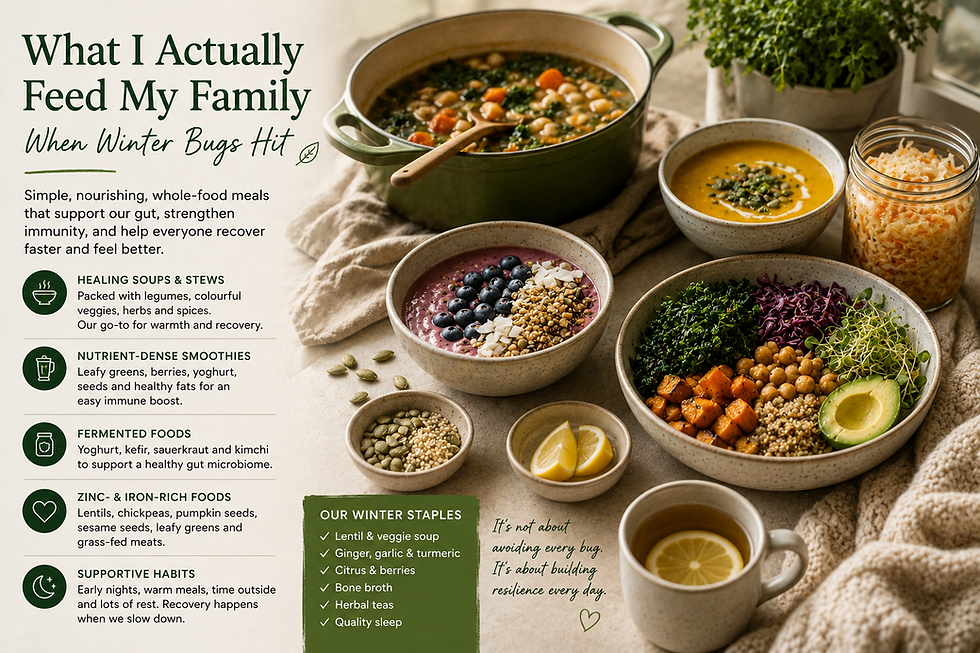
WHAT I ACTUALLY FEED MY FAMILY WHEN THE WINTER BUGS HIT
Last week, when my kids came home sick, I made chicken noodle soup (recipe on my blog) using a whole chicken, bone broth, carrots, celery, onion, red onion, garlic, herbs, noodles, and extra vegetables.
After making the soup, I used the leftover bones and cartilage to create a homemade bone broth, which became the base for future soups, stews, sauces, and meals throughout the week.
When someone is sick, I am thinking about hydration, warmth, protein, minerals, gut support, and getting as many nutrient-dense foods into them as possible without making meals complicated.
Soup is perfect for that because it is easy to digest, hydrating, comforting, and a simple way to include lots of vegetables, protein, and fluids all in one meal.
My mental checklist when building a soup for immune support:
At least five different vegetables or plant foods
A bean or lentil (chickpeas, cannellini beans, red lentils)
Bone broth as the base
A quality protein source (chicken, fish, slow-cooked meat, or extra legumes)
A complex carbohydrate (potato, sweet potato, brown rice, or barley)
One soup can contain close to 10 different plant foods in a single meal, which is fantastic for supporting the gut microbiome during winter.
SUPPLEMENTS HAVE A PLACE, BUT FOOD COMES FIRST
If someone asked me where to start with winter immunity supplements, I would say vitamin D first, then zinc, then vitamin C in that order.
Vitamin D comes first because during winter we are not getting the same sun exposure. We are covered up more, spending more time indoors, and research shows vitamin D deficiency is very common during the colder months. Vitamin D plays an important role in immune regulation.
Zinc would be my next priority because the research around zinc and immune support is strong, particularly around helping support the body during common winter bugs and potentially reducing how long symptoms linger when taken appropriately.
Vitamin C still has a place, but it gets more attention than it probably deserves based on the research.
That said, I am still very much a food-first practitioner. Supplements can be incredibly helpful, and for some people they are necessary. But food does so much more than provide isolated vitamins and minerals.
Plants, vitamins, minerals, fibre, antioxidants, and phytonutrients were always meant to be consumed together rather than in isolation. They work synergistically to support the body's needs.
When we improve the quality and diversity of someone's diet, we are supporting gut health, fibre intake, blood sugar regulation, protein intake, energy levels, recovery, and long-term behaviour change all at the same time.
That is the sequencing piece that matters.
If someone relies only on supplements without addressing the foundation—poor sleep, high stress, low protein intake, low fibre intake, highly processed foods, minimal plant diversity—then supplements end up acting more like a temporary band-aid rather than creating meaningful long-term health change.
Build the foundation through food and lifestyle first. Identify gaps, deficiencies, increased needs, or seasonal demands second. Use targeted supplementation to support and enhance those foundations third.
WHAT ACTUALLY MAKES PROTOCOLS STICK
One of the biggest things I focus on is behaviour change that fits into someone's real life.
Research might suggest eating all organic produce, buying fresh berries year-round, having expensive cuts of protein, or constantly cooking everything from scratch. But for many families, especially during winter, that is not financially or practically sustainable.
So my approach is always to meet people where they are and focus on what is realistic for their lifestyle, budget, cooking ability, and family demands.
I encourage people to use frozen vegetables all the time. Frozen peas, corn, spinach, broccoli, mixed vegetables, or berries are incredibly nutritious, budget-friendly, convenient, and perfect for soups, stews, curries, smoothies, and family meals.
You do not need everything to be fresh or organic to improve your health.
The same goes for beans, lentils, and chickpeas. Regular canned or dried legumes are still incredibly affordable and nutrient-dense. For just a couple of dollars, you can add fibre, plant protein, minerals, and gut-supportive nutrients to meals very easily.
What I often find is that people think healthy eating has to look perfect to be worthwhile. But consistency matters far more than perfection.
That is why I love meals like soups, stews, curries, tray bakes, and slow-cooked meals during winter. They allow families to stretch ingredients further, feed multiple people for multiple days, reduce stress around cooking, and pack a huge amount of nutrients into one affordable meal.
WINTER HEALTH IS ABOUT RESILIENCE, NOT PERFECTION
I am absolutely supportive of prevention. There are many things we can do to reduce risk—supporting gut health, prioritising sleep, washing hands, staying on top of nutrition, and correcting common nutrient deficiencies like low vitamin D.
But I also think it is important to be realistic, especially for parents. When you have children in daycare, school, sports, and everyday social environments, exposure to winter bugs is simply part of life.
So for me, the shift is less about chasing the idea of never getting sick, and more about asking: how do we support the body to be more resilient when sickness does happen?
Instead of creating fear around illness or expecting perfection, I want people to feel empowered by the things they can control—nourishing meals, gut health, hydration, vitamin D, zinc, sleep, recovery, stress management, and listening to the body early rather than pushing through exhaustion.
Because the reality is that life keeps moving during winter. Parents still have to parent, people still have to work, and families still have responsibilities even when they are run down.
My approach is about helping people recover better, reduce the severity or duration where possible, and support their bodies in a sustainable and realistic way rather than chasing the impossible goal of avoiding every single bug.

WHAT TO DO NEXT
If you want to support your gut and immune system this winter, start here:
Track your plant diversity for one week. Count every fruit, vegetable, herb, spice, bean, lentil, chickpea, nut, seed, and whole grain you eat. Aim for 20 to 30 different types across the week.
Add one legume to your meals this week. Throw chickpeas into a salad. Add lentils to your soup. Make a bean-based chilli. Start small and build from there.
Make one soup or stew with at least five different plant foods. Use frozen vegetables if fresh is not realistic. Use canned beans if dried feels too complicated. Focus on variety, not perfection.
Check your vitamin D levels. If you have not had your levels tested recently, talk to your healthcare provider about supplementation during winter.
Prioritise sleep and hydration. Aim for 7 to 8 hours of sleep consistently. Drink at least 1.5 to 2 litres of water per day. Add an electrolyte supplement if you are sick, fatigued, or recovering.
Winter health is not about avoiding every bug. It is about building a foundation strong enough to recover well when life throws something at you.
Your gut is running your immune system. Feed it well.


Comments